









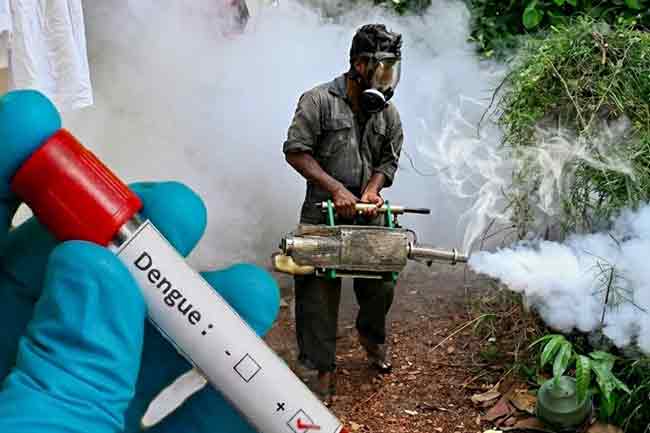
Despite early warnings about a potential dengue outbreak, the number of reported dengue cases has increased sharply due to the failure of certain authorities and officials to implement timely preventive measures, according to the Health Entomology Officers’ Association.
The Association’s President, Najith Sumanasena, stated that the Breteau Index, which measures the density of dengue mosquito larvae, had been steadily increasing since January and had exceeded 25 percent in many areas by April.
Sumanasena noted that the relevant provincial authorities were informed of the situation in April through the Director of the National Dengue Control Unit. However, delays in decision-making by officials in certain divisions contributed significantly to the escalation of the outbreak, he said.
He further explained that the re-emergence in 2026 of the same dengue virus strain that was prevalent in 2017, combined with low levels of immunity among the population, has also contributed to the rise in infections.
He further said that the relevant authorities had been informed of the situation in April, following which the Director of the National Dengue Control Unit had notified the respective provincial administrations.
“However, there were delays in decision-making by certain officials and authorities in some divisions. While some areas responded promptly to the warnings, others failed to take the necessary action. One of the primary reasons for the sharp increase in dengue cases reported by June is the delay in implementing preventive measures, despite forecasts indicating the likelihood of such an outbreak. Another contributing factor is the re-emergence of the viral strain that circulated in 2017, against which many people currently have limited immunity,” he said.
Meanwhile, Dr. Prashila Samaraweera, Community Physician Specialist at the National Dengue Control Unit, stated that 45,037 dengue cases and 28 deaths had been reported island-wide so far in 2026.
She further noted that a particularly high number of cases continues to be reported from the districts of Colombo, Gampaha, Matara, Kalutara, Ratnapura, Galle and Nuwara Eliya.
Dr. Samaraweera also urged the public to remain vigilant, emphasizing that reducing the spread of dengue required collective action.
“Eliminating mosquito breeding sites remains the most effective method of controlling the disease. If everyone regularly inspects their surroundings and removes potential breeding grounds, we can significantly reduce the spread of dengue. We look forward to the cooperation of the public in this effort,” she added.


